

Why Training people doesn't Build AI Capability
People, Culture and Sustained Enablement is the lowest-scoring pillar in the entire AI Maturity Index research baseline, at 13%. Lower than strategy....
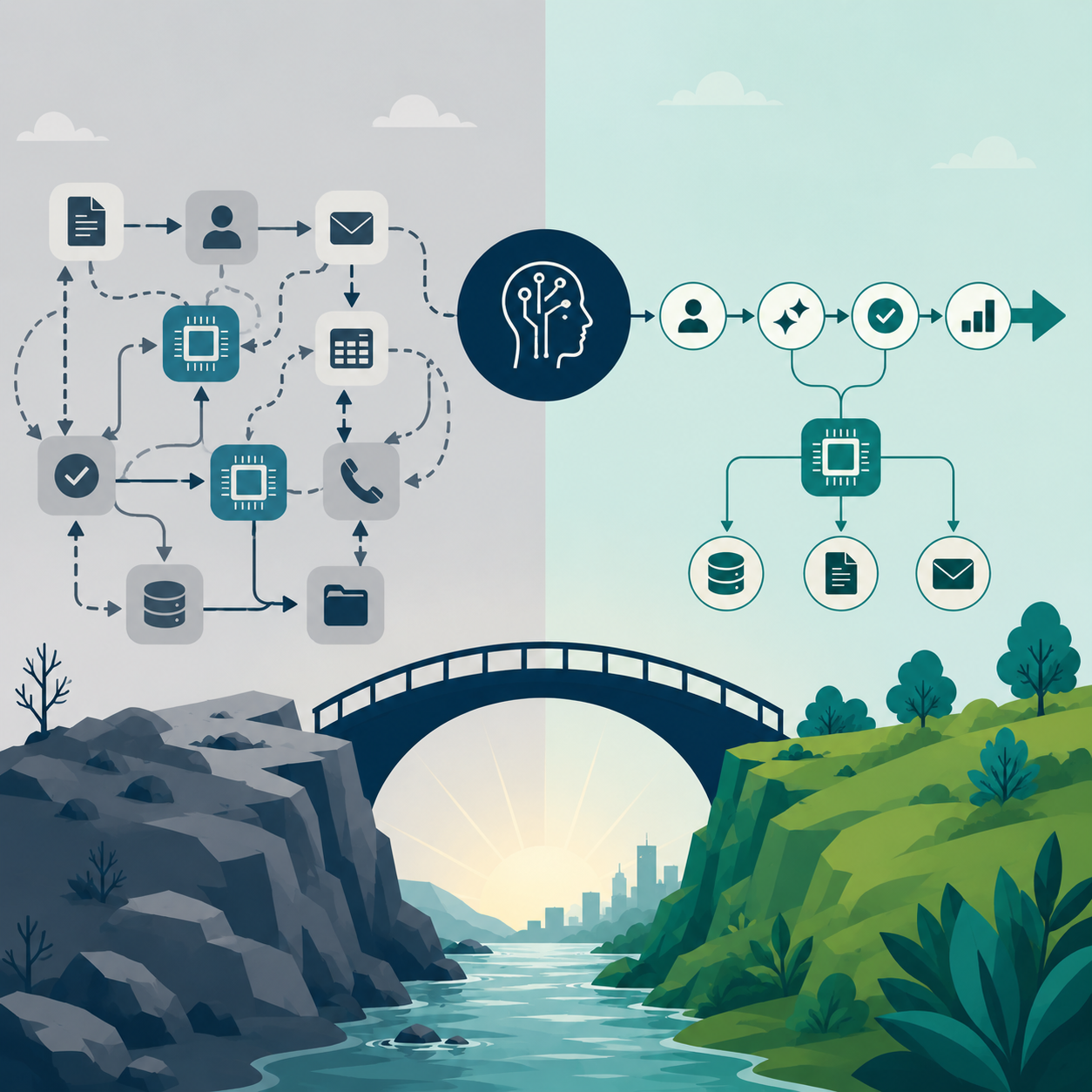
Technology Architecture is the highest-scoring pillar in the AI Maturity Index research baseline, at 27%. On the surface, that sounds like good news — organisations are further along on technology than on strategy, data, process, or people.
It isn’t good news. It’s the most misleading number in the entire benchmark.
A high score on technology relative to the other pillars doesn’t mean organisations have a deliberate AI architecture. It means buying tools is easy, so organisations have done a lot of it — without the strategy, integration, or governance to make those tools add up to anything. Technology Architecture scoring highest isn’t a sign of strength. It’s a sign that the easy part has been mistaken for the whole job.
AI technology architecture is the deliberate framework an organisation uses to decide how AI tools are selected, integrated, secured, and evolved across its commercial stack — as opposed to a collection of disconnected point solutions adopted independently by whoever found them first.
The g2m AI Maturity Index measures technology architecture across five dimensions: how AI tools are selected and deployed; how well those tools integrate with core commercial systems; the maturity of AI security and usage governance; whether tools can share context with each other; and how future-proof the overall architecture is against vendor lock-in. An organisation can score reasonably on any one of these in isolation — plenty have a security policy, or one well-integrated tool — and still have no real architecture at all.
Build, Buy, and Orchestrate are the three deliberate paths an organisation can take when investing in AI capability, and a mature technology architecture applies the right one to each decision rather than defaulting to whichever is most familiar.
Build
When you are the IP
Custom models trained on proprietary data. High cost, high control. The right choice when your competitive advantage is the model itself — not when AI is simply supporting an existing commercial process.
Example: A pathology company training diagnostic AI on ten years of its own patient data.
Buy
When speed matters
Packaged AI tools — Copilot, HubSpot Breeze, and similar. Fast to deploy and lower risk, but constrained by the vendor’s roadmap and prone to becoming another silo if not deliberately integrated.
Example: Enabling HubSpot Breeze for a sales team in a single day.
Orchestrate
Where mature organisations live
Connecting best-of-breed tools into coordinated workflows via APIs or protocols like MCP. Not locked into a single vendor, and scalable as needs evolve — this is the path that turns a pile of tools into an actual architecture.
Example: Meeting notes → CRM update → draft follow-up, automated across three separate tools.
Buy for speed. Build for differentiation. Orchestrate for scale.
Most B2B organisations default to Buy for everything, because it’s the fastest path to visible activity. That’s not wrong as a starting point — but an organisation that never moves beyond Buy ends up with exactly what the research describes: a fragmented portfolio of disconnected tools that each work in isolation and add up to very little.
AI tool integration matters more than tool selection because an unintegrated tool, however capable, operates on incomplete information and produces output that has to be manually reconciled with everything else happening in the business. Picking the best AI tool in its category solves a narrower problem than most organisations think it does.
ServiceNow’s 2026 research found that only 16% of organisations have genuinely integrated AI platforms — down from 30% the year before, as more tools were adopted faster than they were connected. BCG’s research cites fragmented tool portfolios in 60% of organisations classified as AI laggards. The pattern is consistent: adding more tools without integrating them doesn’t compound capability. It compounds fragmentation.
The maturity marker here isn’t how many AI tools an organisation has bought. It’s whether those tools can share context and hand off tasks automatically across a workflow — a meeting note becoming a CRM update becoming a drafted follow-up, without a human manually bridging each step.
The lowest maturity level on tool selection in the AI Maturity Index is: we adopt AI tools reactively as they become available or are requested. Paired with the lowest level on integration — our AI tools operate independently of our core commercial systems — this describes the majority starting position for B2B organisations.
In practice, this looks like:
• Different teams running different AI tools, none of which talk to each other or to the CRM
• No formal AI security or usage policy — employees are using consumer AI tools on company data with no governance
• Heavy lock-in to a single vendor, with no flexibility to adopt better tools as they emerge
• Tool decisions made by whichever team asked first or found the best deal, not by a coherent framework
None of this is unusual. It’s the default state for an organisation that has engaged with AI primarily through procurement rather than through architecture.
The highest maturity level represents an organisation that treats AI technology decisions the same way it would treat any other deliberate infrastructure investment:
• A clear Build / Buy / Orchestrate framework is applied to every AI investment decision — not chosen case by case on instinct
• AI tools are fully integrated, with data flowing automatically across the customer journey without manual intervention
• A mature AI governance framework exists — security, data privacy, ethics, and usage policies are documented and actively enforced
• Tools are orchestrated: they share context and hand off tasks automatically across the go-to-market workflow
• The architecture is deliberately modular — new AI capabilities can be adopted without rebuilding the stack from scratch
Very few organisations are here. But it’s a reachable state, and it doesn’t require betting everything on Build. Most mature architectures are mostly Buy and Orchestrate, with Build reserved for the narrow cases where the model itself is the competitive advantage.
Technology architecture is the pillar most likely to create a false sense of progress. An organisation can score well here in isolation while data readiness (Pillar 2) remains poor — and the result is sophisticated tools producing confident output from unreliable inputs. The architecture amplifies the data problem rather than solving it.
Equally, technology without process redesign (Pillar 4) produces automation of an existing broken workflow rather than genuine improvement — a well-integrated tool bolted onto a process nobody has rethought. And without executive mandate (Pillar 1), technology decisions get made bottom-up by whichever team has budget, which is precisely how fragmented portfolios happen in the first place.
This is why the highest pillar score in the research — 27% — should be read with caution rather than relief. Technology is the pillar organisations find easiest to invest in, which is exactly why it’s the pillar most likely to mask weakness everywhere else.
The AI Maturity Index measures technology architecture across five questions: tool selection approach, integration with core commercial systems, security and governance maturity, cross-tool context sharing, and future-proofing against vendor lock-in. Your score here — read alongside your other four pillar scores — shows whether your technology investment is building real capability or just adding to the pile.
Free · 10 minutes · Instant results · Personalised report from g2m’s AI go-to-market specialists
Build, Buy, and Orchestrate are three deliberate approaches to AI technology investment. Build means training custom models on proprietary data — high cost and control, suited to cases where the model itself is the competitive advantage. Buy means adopting packaged AI tools quickly, trading some control for speed. Orchestrate means connecting best-of-breed tools into coordinated workflows via APIs or protocols like MCP — the approach mature organisations use to scale without vendor lock-in. The guiding principle is: buy for speed, build for differentiation, orchestrate for scale.
Because buying individual AI tools is fast and low-risk, while building an integrated architecture requires deliberate planning, governance, and cross-team coordination. Organisations default to adopting tools reactively — whoever requests one gets it — without a coherent framework for how those tools should connect, share data, or hand off tasks. This produces a portfolio of disconnected point solutions that each work individually but don’t compound into real capability.
Integrated AI tools share data and context automatically across an organisation’s commercial systems, without manual extraction or human intermediaries. For example, a meeting note can automatically update a CRM record, which can then trigger a drafted follow-up email — all without a person manually bridging each step. ServiceNow’s 2026 research found only 16% of organisations have genuinely integrated AI platforms, down from 30% the prior year, as tool adoption has outpaced integration effort.
AI governance is the set of documented and enforced policies covering AI security, data privacy, ethics, and usage across an organisation. Without it, employees often use consumer AI tools on sensitive company or customer data with no oversight, creating security and compliance risk. Mature AI governance includes defined usage guidelines, security controls, and clear accountability — not just an awareness that policies are needed.
A high technology architecture score relative to other pillars often reflects that buying AI tools is easier than building strategy, data foundations, or process redesign — not that an organisation has a mature, integrated AI capability. Research shows fragmented tool portfolios are common even among organisations with relatively high technology investment. Technology architecture without strong data readiness, process redesign, and executive mandate tends to amplify existing weaknesses rather than compensate for them.
• Part 1: Who Should Own AI in Your Organisation? The Case for an Executive Mandate
• Part 2: Why Your Data Is Probably Your Biggest AI Constraint
• Part 3: Why Buying AI Tools Isn’t the Same as Having a Strategy
• Part 4: The Difference Between Automating and Redesigning
• Part 5: Why Training Events Don’t Build AI Capability
Or start with the overview:
→ We’re Building Australia’s First AI Maturity Benchmark — Here’s Why We Need You In It
Subscribe to our latest news and updates on HubSpot.
People, Culture and Sustained Enablement is the lowest-scoring pillar in the entire AI Maturity Index research baseline, at 13%. Lower than strategy....

Process Redesign is the second-lowest scoring pillar in the AI Maturity Index research baseline, at 17%. Only people and culture scores lower. And...
Technology Architecture is the highest-scoring pillar in the AI Maturity Index research baseline, at 27%. On the surface, that sounds like good news...