

Why Training people doesn't Build AI Capability
People, Culture and Sustained Enablement is the lowest-scoring pillar in the entire AI Maturity Index research baseline, at 13%. Lower than strategy....

1 min read
Chris Fell
Updated on June 12, 2014
The results of Marketing Sherpa’s 2012 Lead Generation Benchmark Survey are in!
The results show a stunning reversal of fortune for traditional outbound interruption-styles of marketing in favour of online marketing tactics, becoming known as inbound marketing. These tactics are designed to "get you found" by your target audience online, to attract them to you, like a giant magnet.
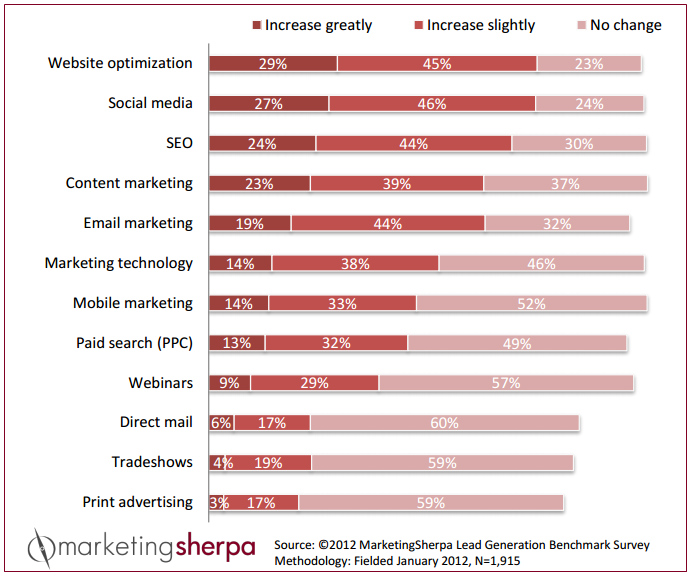
Marketing Sherpa’s 2012 Lead Generation Benchmark Survey asked 1,915 marketers to tell them where their organisations plan to allocate their money in 2012.
According to the study, the tactics that will receive the greatest increases in budget for 2012 include website optimisation, social media and SEO and revealingly, content marketing.
Conversely, the tactics receiving the lowest increases are all outbound, including print advertising, tradeshows and direct mail.

These figures clearly demonstrate the increasing value placed upon online lead generation tactics.
Many marketers continue to struggle against limited budgetary resources in their efforts to generate high-quality leads. The fact that an inbound marketing lead costs on average 62% less to generate than an outbound lead, is only accelerating the switch.
Marketing is seen as as a cost center and Sales as a revenue generator. If marketers are to be taken seriously and barter effectively for increased budget, they need to be able to demonstrate how to tie marketing investments to revenue and show real ROI to the senior executive team.
If you are interested in learning more about how your organisation measures up to the Marketing Sherpa survey findings, you should consider taking our complimentary inbound marketing assessment.
Are you upping your marketing budget in certain areas? If so, where and why? Share with us in the comments section below.
Subscribe to our latest news and updates on HubSpot.
People, Culture and Sustained Enablement is the lowest-scoring pillar in the entire AI Maturity Index research baseline, at 13%. Lower than strategy....

Process Redesign is the second-lowest scoring pillar in the AI Maturity Index research baseline, at 17%. Only people and culture scores lower. And...
Technology Architecture is the highest-scoring pillar in the AI Maturity Index research baseline, at 27%. On the surface, that sounds like good news...